ECTRIMS organises Summer Schools on topics of clinical and scientific interest in the field of multiple sclerosis. Held in European locations, the programme accepts a limited number of participants and is designed to facilitate discussion and interaction. The outcomes from each programme are typically published in an internationally recognised journal.
ECTRIMS Summer Schools
ECTRIMS Summer Schools
Previous Summer Schools
ECTRIMS has hosted a number of Summer Schools since first launching in 2013. Due to the global COVID-19 pandemic, the ECTRIMS Summer Schools 2020 and 2021 were cancelled.
2026: Statistical Techniques & Tools in MS Research
8-10 JUNE 2026 — NAPLES, ITALY
The 2026 ECTRIMS Summer School provided a solid foundation in standard statistical techniques and tools, combining a theoretical component – covering core statistical concepts and study design – with a practical component focused on the application of statistical methods to MS datasets. Participants were allocated to one of two groups, Beginners or Advanced, based on their prior experience.
Participants were early-career researchers who wanted to develop independence in basic data analysis and the use of statistical techniques. This programme was not intended for individuals with advanced expertise in statistics (e.g. mathematicians or professional statisticians), but rather for those seeking to strengthen their research and analytical skills. Preference was given to neurologists and other health professionals involved in MS research or clinical care. A basic understanding of research methodology, including clinical trials, study design, and interpretation of statistical tests, was expected.
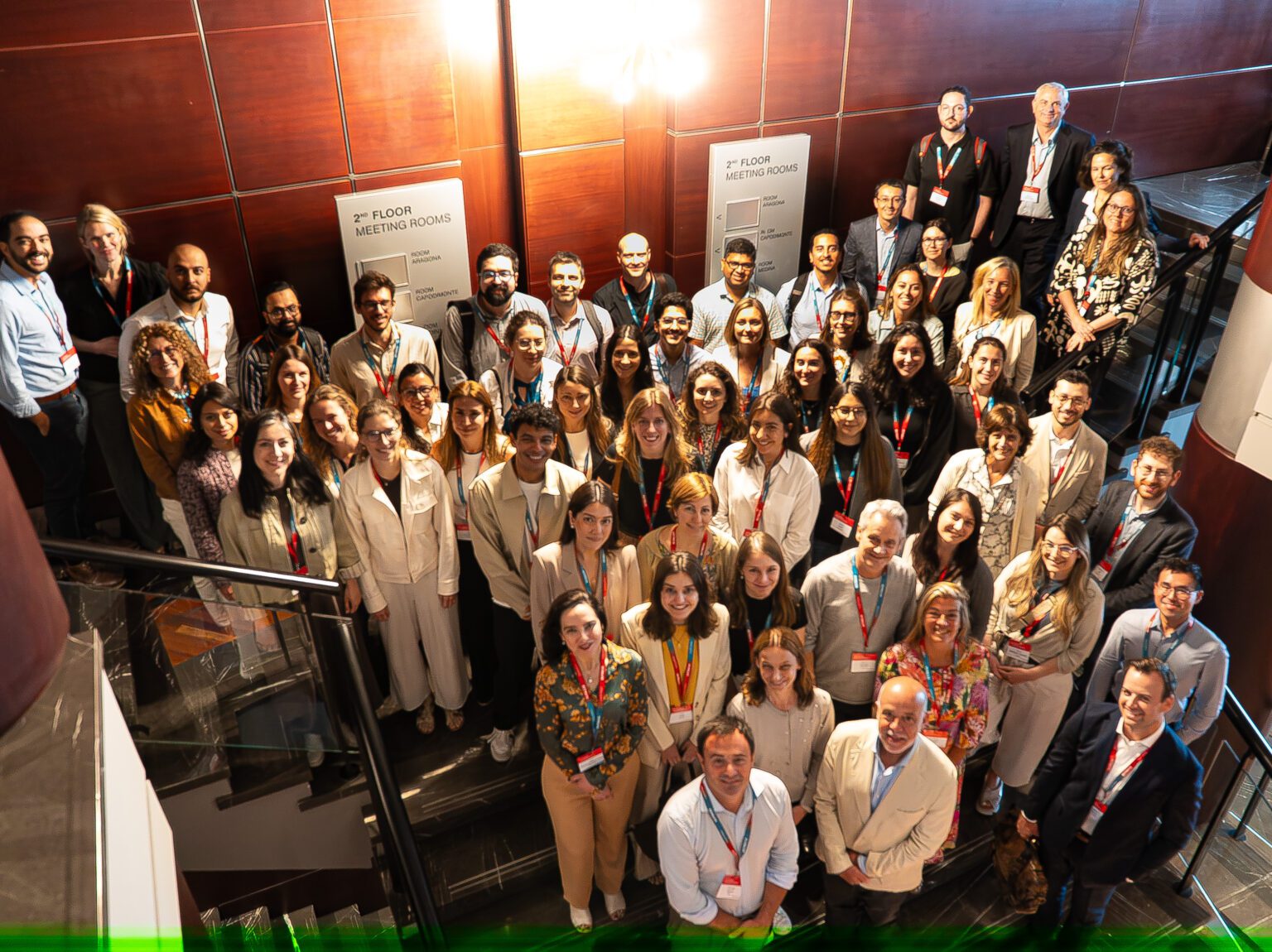
2025: Visual System Evaluation in MS and Other Demyelinating Diseases
2-4 JUNE 2025 — STOCKHOLM, SWEDEN
The 2025 Summer School focused on the role of the visual pathway in diagnosing and monitoring multiple sclerosis and other demyelinating diseases. The programme included lectures on successes and challenges in visual pathway assessments, the use of multimodal visual pathway metrics, emerging technologies like eye tracking, and the application of artificial intelligence.
Sessions explored diagnostic tools, including optical coherence tomography, visual evoked potentials, and MRI, along with their applications, limitations, and implications in both clinical practice and research. Special discussions addressed the differential diagnosis of optic nerve conditions, including paediatric cases and conditions beyond demyelination. Finally, participants were able to take part in hands-on workshops on these techniques mentored by experts in the field.
This comprehensive Summer School programme provided attendees with both in-depth theoretical knowledge and practical skills to advance their work in visual pathway assessments for demyelinating diseases.
2023: From Biological Basis to Ecological Implications of Rehabilitation in MS
27-29 JUNE 2023 - GDANSK, POLAND
Multiple sclerosis (MS) is a disease that causes a multitude of symptoms: visual disturbances, weakness, spasticity, walking impairment, balance and coordination disorders, tremor/ataxia, bladder and bowel disorders. Furthermore, “invisible” symptoms such as fatigue, depression, and cognitive dysfunction are also well represented. In parallel with the advances of pharmacological treatments, MS needs an effective comprehensive, multidisciplinary treatment, which is at the basis of the concept of rehabilitation. Moreover, rehabilitation in MS is also responsible of facilitating reorganising mechanism within the CNS.
The summer school – organised together with Rehabilitation in MS (RIMS) – gathered international experts in the field to provide a “state of the art” update on: biological and ecological implications of rehabilitation, how measuring MS with a set of outcome measures and devices is relevant to plan a personalised rehabilitation treatment; how the use of technology in rehabilitation could be useful to improve its effectiveness and a view on the “around the corner” technologies that will be applied in rehab. Finally, the last session was dedicated to the advancements on the design of clinical trial in rehab, taking into account, in particular, the use of digital markers. All the theoretical sessions were followed by practical and interactive working groups that involved all participants in apply the concepts on outcome measure, technologies in rehab and clinical trials in rehabilitation. The target audience was represented by young neurologists, physiatrists, physical therapists, occupational therapists, and psychologists with interest in this area who want to deepen and implement their expertise in the field.
2022: Cognition and Behaviour in Multiple Sclerosis
20-22 June 2022 — Vienna, Austria
Cognitive impairment is one of the most common and debilitating symptoms in MS, affecting approximately 50% of the patients. Cognitive deficits have a significant impact on patients’ quality of life and have an important prognostic value that justifies their early detection.
The summer school gathered international experts in the field to provide an updated and comprehensive review of the field. It addressed physiopathology, assessment by neuropsychological tests and ecological evaluation, risk factors, structural and functional imaging correlates of cognitive deficits, neuroplasticity, behavioural problems, pharmacological and behavioural treatments, cognition in paediatric MS, and impact on daily life.
Participants were given opportunities to apply the concepts via practical and interactive activities integrated throughout the course. The school targeted young neurologists, neuropsychologists, psychiatrists, speech/ language pathologists, occupational therapists, neuroradiologists with interest in this area and basic knowledge of neuropsychology, who wanted to deepen and implement their expertise in the field.
2019: Methodology of Study Design and Statistical Analysis
18–20 June 2019 — Dublin, Ireland
The ECTRIMS Summer School 2019 focused on the fundamental aspects of research methods and statistics in recent MS research. It gathered international experts in the field to provide an updated and comprehensive review of research methodology, selection and formulation of research problems, research design and plan in the field of aetiology, prognosis and treatment of MS. Experimental designs in different phases of clinical trials and innovative trial designs as well as methodological aspects pertaining to post-marketing, observational studies were discussed together with the methodology to develop and implement clinical guidelines.
Frontal lectures were integrated with relevant examples and guided discussions of papers from the recent MS literature throughout the sessions of the course. In parallel, the fundamentals of statistical methodology and analysis were addressed in the course: testing of hypotheses, traditional statistical approaches together with innovative statistical techniques for processing and analysis of data, interpretation and drawing inferences.
2018: Optical Coherence Tomography in Multiple Sclerosis
25–27 June 2018 — Budapest, Hungary
The ECTRIMS Summer School 2018 focused on optical coherence tomography (OCT) in multiple sclerosis. Retinal OCT permits evaluation of retinal pathology caused by MS, MS-associated optic neuritis or treatment side effects. In addition, OCT is a validated outcome measure for treatment trials in MS. The school provided a detailed overview of the use of OCT in clinical neuroimmunology.
Lectures addressed different aspects of OCT in optic neuritis, MS and related diseases. The participants underwent intensive practical, hands-on training on performing retinal OCT examinations, OCT quality control and conducting supervised retinal segmentation. The participants also trained in case scenarios on how to implement the OCT technique into daily clinical practice.
2017: Symptomatic Treatment and Rehabilitation
13–15 June 2017 — Santiago de Compostela, Spain
The ECTRIMS Summer School 2017 gathered young researchers and clinical experts from different backgrounds (neurologists, rehabilitation physicians and multi-disciplinary therapy teams) who want to generate and implement the best evidence-based treatment and rehabilitation care. Participants learned about the indications and concepts of symptomatic treatment and rehabilitation and its effects according to the different levels of the international classification of functioning including taking into account personal and environmental factors and documenting ecological impact.
2016: Use of MR Imaging in Diagnosis and Management of Multiple Sclerosis
28–20 June 2016 — Vienna, Austria
The ECTRIMS Summer School 2016 was directed at young MS clinicians and investigators to equip them with the knowledge and expertise they need to (i) accurately diagnose MS, (ii) evaluate the effectiveness of drugs in MS, (iii) understand the value of non-conventional and quantitative MR for assessing the structural, metabolic and functional damage, and (iv) become familiar with the different techniques used for imaging analysis.
2015: Remyelination: From Mechanisms to Medicines
16–18 June 2015 — Nice, France
2014: Genetics in MS
2–27 June 2014 — Tallin, Estonia
The course focused on genetics in MS. Participants with no previous knowledge in the field of genetics or who are at an early stage of their training were invited to attend an introductory workshop on genetics research. The workshop covered the topics such as how to read and write a genetics paper. Young scientists also worked with mentor groups and received concrete guidance on reading/ producing genetics papers.
2013: Phase IV Studies: New Methods in Pharmacovigilance and Monitoring Drug Effectiveness in Multiple Sclerosis
25–27 June 2013 — Bari, Italy
The school focused on equipping young physicians with the knowledge and expertise to conduct phase IV studies aimed at evaluating the effectiveness and safety of treatments for MS in clinical practice.