MS Research Briefs: MRI Biomarkers, Machine Learning and the Future of MS Diagnosis
MS Research Briefs: MRI Biomarkers, Machine Learning and the Future of MS Diagnosis
Welcome to MS Research Briefs, a new ECTRIMS podcast series delivering an expert guided tour of important new studies in multiple sclerosis research.
In each episode, leading MS experts will take a small number of recently published studies and go beyond the headline findings – exploring what the research shows and how it may influence clinical practice and future discovery.
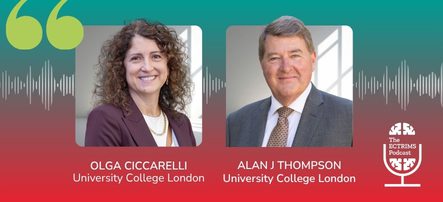
In this inaugural episode, Prof. Alan Thompson and Prof. Olga Ciccarelli discuss two studies exploring how advanced MRI biomarkers and machine learning may transform the diagnosis and prognosis of multiple sclerosis.
Featured Publications
Paramagnetic Rim Lesions and Development of Clinical MS in Radiologically Isolated Syndrome.
JAMA Neurology. 2026;83(3):250–258.
Machine learning-based combination of the central vein sign, cortical lesions and paramagnetic rim lesions: a web-based tool for the diagnosis of multiple sclerosis.
Brain Communications. 2026;8(2):fcag079.
Discussed in this episode
- Can paramagnetic rim lesions identify individuals with radiologically isolated syndrome (RIS) who are most likely to develop clinical MS?
- Why do paramagnetic rim lesions appear to be stronger prognostic biomarkers while the central vein sign remains a powerful diagnostic biomarker?
- Can machine learning models combining MRI biomarkers outperform traditional dissemination-in-space criteria?
- What role might advanced MRI biomarkers play in future diagnostic criteria and treatment decisions?
- How close are we to AI-supported diagnosis and automated biomarker detection in routine clinical practice?
As advanced MRI biomarkers move from research tools towards clinically meaningful decision-making, this episode explores one of the most important developments in contemporary MS research.
This ECTRIMS podcast episode is supported by an educational grant from Alexion, AstraZeneca Rare Diseases. Bristol Myers Squibb, Novartis, Roche, Sanofi, and UCB. Educational grant providers have no input into the podcast series content.